If you’re like me, you’ve been cooking since the pre-dawn hours today. Hopefully you’ve tried some of my low-salt, low-fat recipes and you saw my warning about checking the sodium content of your turkey before buying one.
So all that’s left is to finish the cooking and enjoy. Thanksgiving is perhaps my favorite holiday of the year because it transcends all religions, or lack of religions, and celebrates the American family coming together to give thanks for each other. Time to eat all those turkeys! Happy Thanksgiving!
We will be doing that in a very special way at our house this year, my son is with us from Minneapolis, my wife’s brother is coming over and she has relatives and friends here all the way from Holland to share our special feast.
Editor’s Note: This was written well before the Pandemic had an impact on U.S. food supplies. To read the latest for Thanksgiving 2022, click here. To read about my 2021 turkey quest, click here. To read which items have disappeared from store shelves during the Pandemic, click here.
White-meat turkey is one of the only meats allowed on most low-fat diets. So a traditional Thanksgiving turkey should be no problem right? Think again, I’m afraid. As I’ve written before, any self-basting turkey is loaded with salt, upwards of 300 mgs in four ounces.
If you’re likely to eat much more than four ounces, there goes your salt count for the day. So scout out a fresh or organic turkey with no added salt. I found a great deal on a fresh turkey at Costco today, $1.09 a pound, considerably cheaper than the $2,49 a pound I saw at other retailers carrying fresh birds.
Costco has a great price of $1.09 a pound for fresh, low-sodium Butterball turkeys.
My Butterball fresh has only 70 mgs of sodium per four ounces, what’s naturally in the turkey itself. Always read the nutrition label before buying, I saw some Butterball fresh turkeys at local retailer Jewel that had more salt, I couldn’t tell what the difference was other than the salt content, the labeling looked identical. Continue reading “How to find a low-sodium Thanksgiving turkey”→
Christmas dinner brings out almost as much food as Thanksgiving. I’ve written about some of my favorite Christmas dinner dishes here. If you plan to make another turkey for yours, here’s a low-fat, low-sodium stuffing/dressing you can make to go with it.
The traditional Thanksgiving menu wouldn’t be the traditional menu without some sort of stuffing for the turkey. But pre-made stuffing mixes are loaded with sodium because they’re generally bread-based and most bread is high in sodium.
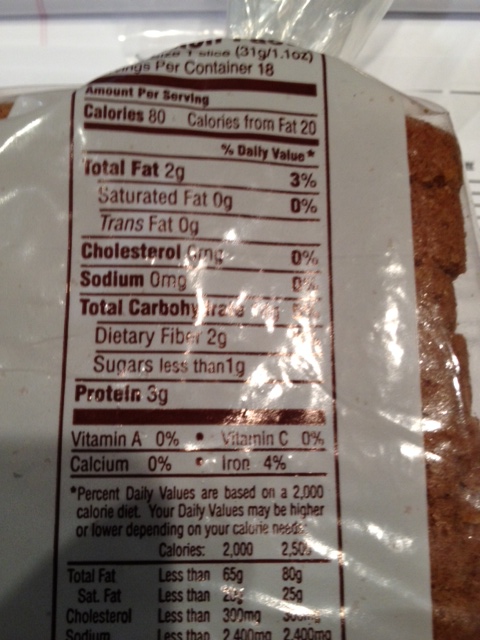
I bought some Stove Top stuffing that is labeled as low-sodium, but that’s a relative term. Half a cup of it contains 250 mgs of sodium. That’s only four ounces, I can’t imagine not wanting to eat more than that on Thanksgiving. Trader Joe’s sodium-free whole wheat bread.
Thanksgiving turkey should be a no-brainer for those watching their salt, fat and sugar intake. The white meat of the turkey (sorry no fatty dark meat or skin on your plate) is lean enough to eat.
But unfortunately, turkeys can hide mountains of salt depending on which kind you buy. Like everything else in the normal grocery store, you need to check the nutrition labels before buying. Why? Because any turkey that includes liquid for self-basting likely has tons of salt in it. Even some that aren’t self-basting also are injected with juices to aid cooking and those juices are salt solutions basically.Beware turkeys like this one that are self-basting. They’re loaded with salt.
Here’s what I found on a walk past the turkey cases at a local Jewel supermarket in the Chicago area. The first turkey I looked at, a self-baster had 230 mgs of sodium per serving. Compare that to a fresh turkey I found that has between 50 and 70 mgs per serving.
As you likely know, the biggest change you face when you get put on a restricted diet is that buying prepared or processed foods of any kind becomes nearly impossible because of the amounts of sodium, sugar and fat in them. You are forced to cook for yourself, learning if you haven’t cooked before or relearning if you had cooked but used the big three of forbidden foods that you can no longer eat.
I’ve been a cook all my adult life but have been relearning and refining old recipes to get the salt, sugar and fat out, as I write about here. I pretty much make everything from scratch now and after eight months of doing it, have a fairly good rotation of nightly dinner dishes which I make for my wife and I. But cooking from scratch every night is time consuming, and tiring after long, long days at work.
That’s why I recommend cooking several main courses at once, perhaps on a Saturday or Sunday when you may have more time to prepare. Then you can simply reheat these items and make some quick veggie side dishes during the week. I did that with the items in the picture you see here. Cooking three, or more, meals at once.
The center item is my latest take on a pizza I can eat. It’s made with a whole wheat prepared crust from Whole Foods, salt-free tomato sauce and fat-free mozzarella cheese I get from a local supermarket, along with peppers, low-salt black olives, and mushrooms.
To the right of the pizza is my turkey meatloaf, which includes two pounds of lean and very lean ground turkey combined with low-salt Panko bread crumbs and Eggbeaters (equal to one egg). A meatloaf that size is at least two meals for my wife and I, and easy ones to quickly heat during the week.
To the left are portobello mushroom caps covered in salt-free tomato sauce, no-fat cheese and peppers. I originally cooked these as a main course but we ended up having them as a side dish. Simply bake those at 350 degrees for about 20-30 minutes depending on your oven.
John
White meat turkey is on my approved meat list, but white meat turkey can be drier than paper to eat, as I found out when I was in the hospital last August and ate what passed for a meal of turkey there.
Turkey burgers present the opportunity to use ketchup to flavor them up a bit. But my nutrition nazi had a warning about buying ground turkey or pre-made turkey burgers. Pre-made turkey burgers, such as the ones in restaurants or sold pre-made in supermarkets, contain turkey skin to give them some moisture so their fat content can be as high as that of some red meats.Not all ground turkey is the same. There’s lean and there’s extra lean.




 The No Salt, No Fat, No Sugar Journal