Olive oil is like the Mount Olympus of ‘good’ fat, most nutritionists agree. But exactly why is that the case? So much of nutrition science is still in its infancy that I often am skeptical when anything is touted as a ‘healthy’ food.
Always carry your own oil and vinegar packets to use on any salad. I buy these in bulk on Amazon.
But a new study may give some insight into why olive oil can help us. Apparently it helps your good cholesterol, the HDL kind, work more effectively, according to an article in Cooking Light magazine.
Mushrooms have always been something I enjoy, from cutting up small ones for salads to roasting giant portabellos on the grill with a salt-free teriyaki sauce for flavoring.
So it’s nice to know they have lots of healthful properties, as this slide show from WedMd.com shows.
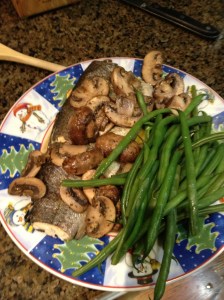
Trout, with mushrooms as a garnish.
“If you’re looking for an all-natural multivitamin, skip the supplement aisle and pick up some mushrooms,” WebMD says. “Among their many nutrients: B vitamins — including pantothenic acid (B5), niacin (B3), and riboflavin (B2) — plus copper and selenium. Mushrooms also have protein, fiber, potassium, vitamin D, calcium, and more.
“Mushrooms may do a lot more for your health than fuel your body. They have antibacterial properties. They can help lower cholesterol. They’re good for your immune system. They may even help prevent or treat Parkinson’s disease, Alzheimer’s disease, high blood pressure, and cancer,” the slide show goes on to state. Wow. I tend to be doubtful about such superfood claims, there’s still so much about nutrition and our bodies that science hasn’t figured out, after all. Continue reading “Consider mushrooms for your Easter table”→
Sunday is movie day in our house. We normally go to the first show of the day to get cheaper tickets because why pay more to see the same movie a few hours later? Movie theaters today are adding all sorts of new perks to get people to leave their houses. One of the new perks is expanded food options.
AMC is a large theater chain and I saw recently that it has what it’s calling the AMC dine-in menu now. The cardboard menu they give you to pick from actually has calorie counts right on it for every dish, a requirement that comes from the healthcare law commonly called Obamacare.
Salt has become my sworn enemy because of its impact on my weight and blood pressure, so I’ve been working hard to redo recipes to get the salt out since my 2012 angioplasty. Check my recipe page for some great recipes that have a minimum of salt.
At least two of these actually sound good to me and don;t seem to compensate for the lack of salt by adding fat and/or sugar. I’d try the Alaskan BBQ Salmon and the Mini Turkey Meatballs. Salmon and ground turkey are two of my go-to proteins these days. I would cut the sugar in the salmon however, honey and sugar seem like too much sweetness and too much sugar. Or use a low-sugar, low-salt barbecue sauce like LocalFolks.
The link to the turkey meatballs isn’t working so I can’t examine the ingredients list, but I like the concept. Try adding Italian seasoning and some low-fat parmesan cheese for flavor.
Healthy Heart Market is a good online shopping alternative if you can’t find low- and no-salt offerings in your local supermarkets or food stores here you shop. I’ve written about it’s offerings in the past.
But shipping products, especially liquids, can get expensive. So it’s nice when the Market offers discount, such as one that is ending today for 10% off. The promotion is tied in with the American Heart Association’s Go Red Day, which was Feb. 3 and is designed to help promote heart health among women. Continue reading “A heart-related discount from Healthy Heart Market”→
Bread has largely been out of my diet since I began efforts to reduce my daily intake of sodium. Most breads, whether packaged or made fresh at local bakeries, are loaded with salt. I’ve worked hard to find a salt-free whole wheat bread and other varieties like a brown rice bread.
My rice bread find from Minneapolis. A nice low-salt alternative to high-sodium white breads.
It’s an informative piece, separating out bread myth from reality and rating various types of bread. I’d hoped it would look at brands of bread too, but no luck on that front. It did take on two of the three food demons — salt and sugar.
“Aim for bread with less than 150 mg of sodium per slice of bread,” Carrie Motschwiller, a registered dietitian and wellness manager in New York City, says in the piece. I’d go further and try to cut out all salt in bread or simply skip the bread. Continue reading “Bread and salt — here’s how to break that troubling link”→
Mountains of salt will remain in processed ad restaurant foods for years to come.
First of all, the guidelines are voluntary, not mandatory, so they don’t crack down on or call for anything, they merely suggest guidelines, which is exactly what the food industry, which has been fighting mandatory limits on sodium, wanted. Continue reading “The FDA’s new sodium guidelines have no teeth”→
Many national restaurant chains these days are trying to adjust menus to offer what they call healthier or leaner meals. It’s a tall order to full when their menu planners remain addicted to salt! I ran into this with Applebee’s last year and just came face-to-face with it again recently when I went to a local Denny’s for breakfast.
Denny’s has what it has dubbed its Fit Fare menu. Items are labeled as “lite” and their protein amounts are highlighted as well. But when you dig into the nutrition info on Denny’s website, you see the sad salt stories.
My Denny’s omelet..get the salt out Denny’s!!!
Take the Fit Fare veggie omelet made with egg whites as an example. I planned to get this, but then saw it contains 820 mgs of sodium, basically half my daily limit! Where is all the salt? I discussed it with a very helpful waitress. We agreed the Swiss cheese used and the English muffin that could be a side likely accounted for most of it. Continue reading “Denny’s Fit Fare menu — loaded with salt”→
WebMD recently did a series of posts about fast food choices which I wrote about recently. The news was mostly bad, especially when it came to salt content of even what WebMD considered the best alternatives in several categories.
A McDonald’s breakfast platter my mother once loved.
This blog is about food and trying to get the salt, fat and sugar out of your diet so you don’t find yourself with a blocked artery leading to your heart as I did in 2012. But any doctor or nutritionist will tell you regular exercise is important to your heart health as well.
I’ve incorporated exercise into my morning routine, normally doing 30 minutes on an exercise bike or rowing machine in my basement along with occasional weights. Lose It, which I use to track all my food consumption, loves sending me badges and recently sent an exercise one. This one shows I’ve exercised off at least 100 calories three times in a week.
One hundred calories is nothing, really, if you’re concerned about your weight. My 30 minutes of biking causes me to burn 350 calories, according the the app. Rowing burns 300, which I find difficult to believe because I feel the rowing is more difficult for me than the biking. Continue reading “Don’t forget to exercise”→






 The No Salt, No Fat, No Sugar Journal